
An overview on "One Health"
Published on Tuesday, September 1, 2026
Let's take a look at the history of these terms and their meanings:
- 1971, Global Health: Introduced by the World Health Organization (WHO) in « The Politics of Global Health » report. This approach takes into account the interactions between globalization, climate change and the determinants of health. In 1993, the WHO assumed the role of international coordinator for Global health.
- 1984, One medicine: Calvin Schwab veterinarian and epidemiologist created the One medicine concept in his book "Veterinary medicine and human health". In this publication, he underlines human and animal medicines' similarities and the need for collaboration to prevent, cure and control effectively shared disease between animals and humans.
- 2004, The Manhattan Principles: Presented in New-York City by the Wildlife Conservation Society (WCS). The first principle focusses on the necessity to acknowledge the links between human health, animal health and environment.
- 2008, One Health: Official launching of the One health approach inSharm el-Sheikh symposium, Vietnam. The aim was to shape a better collaboration between the Alliance parties: WHO, Food and Agriculture Organization (FAO) and World Organization for Animal Health (WOAH) (formerly OIE).
Developed by veterinary and disease ecology communities in response to emerging infectious diseases, the One Health concept has remained fragmented and limited in addressing environmental aspects. To strengthen this approach, the One Health High-Level Expert Panel (OHHLEP) was established in 2020, at the Paris Peace Forum, by WHO, WOAH, FAO, and UNEP (United Nations Environnement Programme). Comprising 26 independent experts, this panel provides guidance and recommendations on the interconnectedness of human, animal, and environmental health to support policymakers and public awareness.
“One Health is an integrated, unifying approach that aims to sustainably balance and optimize the health of people, animals and ecosystems. It recognizes the health of humans, domestic and wild animals, plants, and the wider environment (including ecosystems) are closely linked and inter-dependent. The approach mobilizes multiple sectors, disciplines and communities at varying levels of society to work together to foster well-being and tackle threats to health and ecosystems, while addressing the collective need for clean water, energy and air, safe and nutritious food, taking action on climate change, and contributing to sustainable development.”
The EcoHealth concept was introduced alongside the One Health approach, reinforcing it by considering ecosystem changes and their interactions as a whole, including plant health. A second approach focuses more specifically on identifying and analyzing potential human pathogens through the exploration of biodiversity.
- 2015, Planetary Health: Concept proposed by The Rockefeller Foundation–Lancet Commission, coinciding with the launch of the United Nations Sustainable Development Goals. Planetary health was defined as: “the health of human civilisation and the state of the natural systems on which it depends.” In 2021, the Planetary Health Alliance redefined planetary health as: “a solutions-oriented, transdisciplinary field and social movement focused on analyzing and addressing the impacts of human disruptions to Earth’s natural systems on human health and all life on Earth”.
- The “One Welfare” concept expands the health dimension to include the concept of well-being. It emphasizes that animal and human well-being are interconnected and influence each other’s physical and mental health.
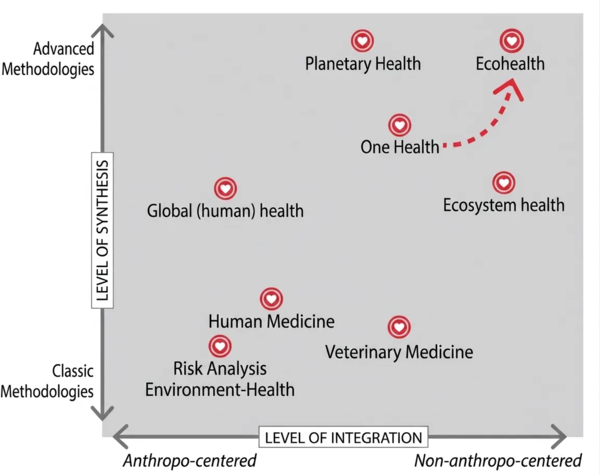
Source: Adapted from Morand, S., Guégan, J.-F., Laurans, Y., 2020.
We are increasingly seeing overlaps between these approaches as the "One Health" concept gains momentum. These overlaps can be a source of confusion, mainly because they often involve different disciplines and communities.
Global health (GH) cannot be considered as a discipline on its own. It is more accurate to define it as a “field” of study and practice at the intersection of many disciplines. GH addresses the need for a “global” vision of One Health, encompassing both the One Health and Planetary Health frameworks, which facilitate the transition from ‘local to global,’ or more precisely from ‘molecular to global,’ in order to address the health, well-being, and sustainability for humans, animals, and the environment.
Planetary Health (PH) emphasizes the link between human health and a healthy planet, focuses more on the environment, particularly climate change and human health, as well as its social determinants.
The Ecohealth concept emphasizes the role of the environment and healthy ecosystems in animal and human health. It focuses on protecting biodiversity and its intrinsic value, as a whole, and on preventing all health threats.
EcoHealth and Planetary Health have significantly expanded the environmental dimension and the range of threats to be considered in public health policies, and have introduced equity considerations.
All these concepts present limits. Some key considerations should be taking into account when referring to them:
- Current thinking is overly anthropocentric: even if all these approaches promote a broader vision of health, animals and the environment are mainly protected to safeguard humans; it is well illustrated by the fight against antibiotic resistance. A shift in perspective is needed, recognizing that diseases can also spread from humans to animals, with major impacts on both wild and domestic species. There is the need of an integrated approach to health, veterinary, and ecological management models.
- Concrete action remains limited, with most efforts staying at the level of recommendations. Existing practices should be better documented and more decisively implemented. For example, in France, health grants are still often limited to one specific area of health (animal, plant, or human), which prevents organizations managing natural areas from applying.
- A global, integrated approach must not overlook persistent social inequalities, which need to be addressed.
- This broader perspective should lead to deeper, more political questioning of our development model.
To conclude, there is a difficulty in truly integrating the three dimensions of human, animal, and environmental health, and, on the other hand, a difficulty in translating into policy the concepts (potentially innovative and ambitious) that have been put forward over the past twenty years to advance progress in this field.
As a reminder, on World Health Day, France hosted the One Health Summit in Lyon last April, 2026.
For the first time, the One Health Summit provided an opportunity to bring together heads of state and government from around the world, representatives of relevant international and regional organizations, parliamentarians, scientists, and representatives from the private sector, civil society, local governments, development banks, and youth organizations to accelerate the implementation of the “One Health” approach.
Faced with intensifying health, climate, and environmental crises, these stakeholders committed to acting collectively to address the major challenges affecting our health and damaging our planet. The commitments made at the One Health Summit, co-chaired by Ghana and France, reflect a shared conviction: to prevent risks rather than having to treat their consequences, the One Health approach is indispensable.
The French Committee of the IUCN has issued recommendations for the effective implementation of the One Health approach. This approach encourages a gradual transformation of our society, essential for addressing the environmental and health challenges associated in particular with pollution and climate change.
- Adopt a national One Health law and strategy, backed by strong interministerial coordination to integrate health into all public policies.
- Prioritize combating illegal wildlife trade and reducing harmful human–wildlife interactions to protect biodiversity and limit disease risks.
- Make biodiversity protection and restoration central to health policy, with dedicated funding and impact assessment tools.
- Strengthen regional involvement in policy implementation.
- Involvement of companies: make the One Health approach a part of their strategy
- Vigilance regarding emerging infectious diseases. Improvement of surveillance and preparedness systems for emerging diseases and endemic zoonotic diseases
- Combating resistance to antimicrobial agents.
- Recognition of disruptions occurring in our environment that may promote the emergence of new diseases, infectious or otherwise, or the worsening of existing conditions: the concept of the exposome.
Although the One Health approach has repeatedly proven its effectiveness, its implementation faces a host of challenges:
- Practical challenges: the lack of global governance
- Ideological challenges: the lack of a clear definition of the public interest, the primacy of the individual over the collective
- Epistemological challenges: the rejection of science’s legitimacy as a source of truth.
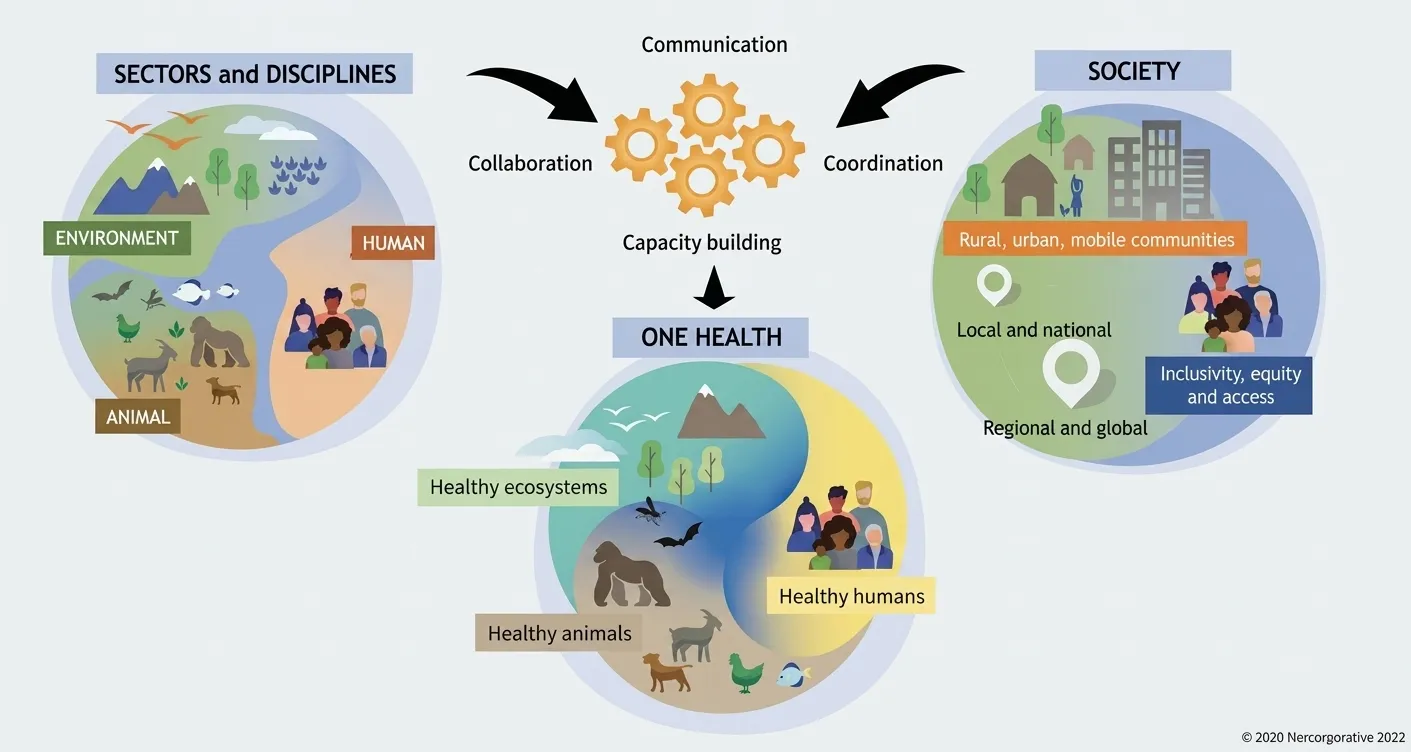
Source : OHHLEP 2021 (opens in a new tab)
Ceva WRF helps provide every scientific project with what it needs: the resources to move forward, the expertise to succeed, and the connections to go further.
Examples of projects that are much more than just One Health ideas:
In September 2025, Australia granted conditional approval for a vaccine against Chlamydia pecorum in koalas. Authorized under an Australian Pesticides and Veterinary Medicines Authority (APVMA) Minor Use Permit (PER94984), the vaccine can be deployed under supervision while its effectiveness continues to be evaluated.
Veterinary vaccines against chlamydial infections are already licensed for use in livestock and companion animals. These include vaccines targeting Chlamydia abortus to prevent enzootic abortion in sheep, and Chlamydia felis vaccines designed to reduce clinical disease in cats.
Challenges
Wildlife vaccines often target small, dispersed populations and generate little commercial profit, yet they demand the same rigorous development, testing, and regulatory processes as human or livestock vaccines. Their long-term progress depends on dedicated funding models that recognize their ecological and public value, including sustained conservation funding, public–private or non-profit partnerships, and regulatory incentives that help offset the costs of developing and deploying vaccines for limited use.
Opportunities
Koalas face many of the same challenges as human chlamydial vaccine development, including unclear immune markers, ethical limits on experimental infection studies, and weak commercial incentives. The C. pecorum koala vaccine shows that valuable advances in vaccinology can arise from unconventional models. Key features of the koala vaccine, such as single-dose strategies, integrated monitoring, and ecological practicality, may help inform future vaccines against C. trachomatis and other intracellular pathogens.
More broadly, cross-species approaches, though still underused, offer strong potential to accelerate progress against emerging and neglected pathogens.
An other example of the importance of shared knowledges and crossed disciplines is the development of an oral vaccine for the Tasmanian devial facial tumor diseases.
Devil facial tumour disease (DFTD) has caused a severe decline in wild populations of the Tasmanian devil (Sarcophilus harrisii). The disease is driven by two distinct transmissible cancers, DFT1 and DFT2, both of which have nearly 100% mortality. Notably, DFT1 cells do not normally express major histocompatibility complex class I (MHC-I) molecules, allowing them to evade detection and response by the host immune system.
Here the challenge: developing a vector able to stimulate MHC-1 component expression on devil facial tumor cells.
Human adenovirus serotype (Ad5) has been extensively used as a gene delivery vector and vaccine platform in humans and other eutherian mammals. However, its ability to transduce marsupial cells and express transgenes had not been established. A 2022 study demonstrated that adenovirus-mediated expression of interferon-gamma (IFN-γ) successfully induced the upregulation of β2-microglobulin—a key component of MHC class I—on DFT1, DFT2, and Tasmanian devil fibroblast cell lines.
These findings demonstrate that human Ad5 can successfully transduce Tasmanian devil cell lines and drive the expression of functional transgenes. This supports further exploration of human adenoviral vectors as platforms for prophylactic vaccines and immunotherapies targeting DFTD, with potential applications for other marsupial diseases.
Dar, Osman Ahmed, Hassaan Zahid, Max Claron, Neil Spicer, et Mishal Khan. « Exploring a One Health Approach to Sustainability with International One Health and Global Health Security Experts – Differences, Similarities and Trade-Offs between Sectors ». PLOS Global Public Health 5, no 12 (2025): e0005225. https://doi.org/10.1371/journal.pgph.0005225.
De Castañeda, Rafael Ruiz, Jennifer Villers, Carlos A. Faerron Guzmán, et al. « One Health and Planetary Health Research: Leveraging Differences to Grow Together ». The Lancet Planetary Health 7, no 2 (2023): e109‑11. https://doi.org/10.1016/S2542-5196(23)00002-5.
Flies, A. S., Flies, E. J., Fox, S., Gilbert, A., Johnson, S. R., Liu, G.-S., Lyons, A. B., Patchett, A. L., Pemberton, D., & Pye, R. J. (2020). An oral bait vaccination approach for the Tasmanian devil facial tumor diseases. Expert Review of Vaccines, 19(1), 1–10. https://doi.org/10.1080/14760584.2020.1711058
Kayigwe, A. N., M. Darby, J., Lyons, A. B., L. Patchett, A., Lisowski, L., Liu, G.-S., & S. Flies, A. (2022). A human adenovirus encoding IFN-γ can transduce Tasmanian devil facial tumour cells and upregulate MHC-I. Journal of General Virology, 103(11). https://doi.org/10.1099/jgv.0.001812
Missoni, Eduardo. « Global Health, Planetary Health, One Health: Conceptual and Ethical Challenges and Concerns ». Theoretical Medicine and Bioethics 45, no 3 (2024): 241‑50. https://doi.org/10.1007/s11017-024-09670-6.
Morand, S., Guégan, J.-F., Laurans, Y. (2020). De One Health à Ecohealth, cartographie du chantier inachevé de l’intégration des santés humaine, animale et environnementale. Iddri, Décryptage N°04/20.
Parodi, A. L. « Le concept “One Health”, une seule santé : réalité et perspectives ». Bulletin De L’Academie Nationale De Medecine 205, no 7 (2021): 659‑61. https://doi.org/10.1016/j.banm.2021.05.001.
Pollak, N. M., Phillips, S., & Timms, P. (2026). Koalas first: Lessons from a wildlife Chlamydia vaccine. Trends in Microbiology, S0966842X26000296. https://doi.org/10.1016/j.tim.2026.02.003
Tovar, C., Pye, R. J., Kreiss, A., Cheng, Y., Brown, G. K., Darby, J., Malley, R. C., Siddle, H. V. T., Skjødt, K., Kaufman, J., Silva, A., Baz Morelli, A., Papenfuss, A. T., Corcoran, L. M., Murphy, J. M., Pearse, M. J., Belov, K., Lyons, A. B., & Woods, G. M. (2017). Regression of devil facial tumour disease following immunotherapy in immunised Tasmanian devils. Scientific Reports, 7, 43827. https://doi.org/10.1038/srep43827
UICN Comité français (2025). Comprendre le concept Une seule santé : Prendre soin des vivants et des milieux pour passer à l'action. Paris, France
Sites
« Focus #8 - Une seule santé / One Health | Promotion Santé IdF ». 8 décembre 2023. https://www.promotion-sante-idf.fr/sinformer/trouver-ressources/ressources-documentaires/focus-8-seule-sante-one-health.
« L’approche One Health : un changement de paradigme indispensable en santé publique - Éducation Santé ». Réflexions. https://educationsante.be/, s. d. Consulté le 5 mai 2026. https://educationsante.be/lapproche-one-health-un-changement-de-paradigme-indispensable-en-sante-publique/.
« One Health, une seule santé | INRAE ». Consulté le 13 mai 2026. https://www.inrae.fr/alimentation-sante-globale/one-health-seule-sante.
Pinet, Paula. « Tripartite and UNEP Support OHHLEP’s Definition of “One Health” ». WOAH - World Organisation for Animal Health, 1 décembre 2021. https://www.woah.org/en/tripartite-and-unep-support-ohhleps-definition-of-one-health/.
Rateau, Mathilde. « Une seule santé / One Health - ORS ». ISEE - Île-de-France SantÉ Environnement. Consulté le 5 mai 2026. https://www.ors-idf.org/isee/actions/focus-une-seule-sante-/-one-health/.
« The Manhattan Principles ». Consulté le 5 mai 2026. https://oneworldonehealth.wcs.org/About-Us/Mission/The-Manhattan-Principles.aspx.
« Une seule santé ». OMSA - Organisation mondiale de la santé animale, s. d. Consulté le 15 juillet 2025. https://www.woah.org/fr/ce-que-nous-faisons/initiatives-mondiales/une-seule-sante/.
Une seule santé : le Comité français de l’UICN appelle à intégrer la biodiversité au cœur des politiques de santé – UICN Comité Français | Préserver la biodiversité. s. d. Consulté le 13 mai 2026. https://uicn.fr/une-seule-sante/.