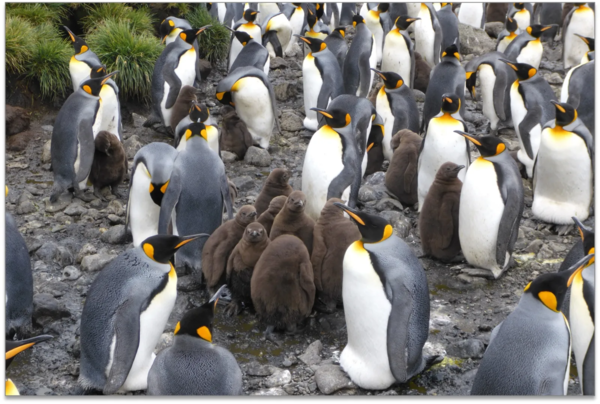


King penguins
King penguins

Southern Lands - Studying avian influenza vaccination in king penguins

In response to the spread of avian influenza among seabirds and the risk of infection reaching subantarctic colonies, this project was established to assess a strategy for protecting wild populations through preventive vaccination. The aim is to evaluate the ability of an avian influenza vaccine to induce an immune response in king penguins in the Crozet Islands archipelago.
The objective is to evaluate the immune response and vaccine efficacy in chicks, in order to determine its capacity to protect them during their prolonged period of vulnerability on land and to contribute to the development of protective solutions for wild bird populations.

Project overview

Location: French Southern and Antarctic Lands (FSAL) 🇫🇷

Project Leader: Dr. Thierry Boulinier (opens in a new tab)  

Status: In progress 

Duration: Undefined (more than 2 years)

Partners: 

Context

An unprecedented global epizootic 


In recent years, influenza viruses have reemerged and are threatening global health. Highly Pathogenic Avian Influenza (HPAI) is affecting seabirds in Europe on a massive scale, an unprecedented situation. Already weakened by global environmental change, these species are particularly vulnerable because they breed in dense colonies, which facilitates the rapid spread of this infectious disease. HPAI (Highly Pathogenic Avian Influenza) is a well-known, highly transmissible infectious disease that affects both domestic poultry and wild birds, and the viruses responsible for it are known to evolve rapidly.


Spread to even the most remote areas 


Since 2022, HPAI has spread globally among wild bird populations, from the North Atlantic to the Pacific and as far as South America, reaching subantarctic regions such as South Georgia and the Falkland Islands by the end of 2023. Previously spared, the French Southern and Antarctic Lands (FSAL) were in turn affected in 2024, notably through “sentinel” species such as scavenging birds (Clessin et al., 2025 (opens in a new tab)). This expansion confirms that even the most isolated ecosystems are no longer protected, with a high risk of rapid disease spread in environments characterized by high animal densities.
 

Focus on the FSAL: a laboratory unique in the world
 

Located in the Southern Ocean, between Madagascar and Antarctica, the FSAL are home to millions of seabirds and mammals in an environment that is as spectacular as it is fragile. On Possession Island (Crozet Archipelago), accessible only after a journey of several days from Reunion Island, scientists work under difficult conditions to study and protect these ecosystems. 


Des pinguins

(©) Mathilde Lejeune CNRS/IPEV


In light of the emergence of HPAI in 2023, innovative research programs are underway. These territories, which are strictly protected and have limited human presence, are now strategic research sites for anticipating and combating this global epizootic disease.

Project challenges

Why vaccinate king penguins? 


King penguins are particularly vulnerable to avian influenza: they live in very dense colonies over an extended period, which facilitates the transmission of the virus. 

The project is based on a unique scientific opportunity: king penguins have a reproductive cycle marked by a chick-rearing phase, during which the chicks remain on land for more than 300 days, providing a particularly long window for intervention and monitoring in a natural environment.  

This unique characteristic makes it possible, for the first time in a wild species, to implement a vaccination and long-term monitoring strategy directly on individual birds during a period of maximum susceptibility. 

The Center for Functional and Evolutionary Ecology (CEFE–CNRS), drawing on its expertise in the eco-epidemiology of seabirds in the TAAF (ECOPATH–IPEV project (opens in a new tab)), is leveraging this unique characteristic to evaluate a novel protection approach under real-world conditions. 

Thus, vaccinating king penguin chicks allows for the testing of a proactive prevention strategy in a particularly vulnerable wild population, while documenting the immune response in a real-world ecological context. The vaccination approach could be particularly valuable for even more threatened populations, such as the smaller populations of other penguin species or the Amsterdam albatross population.

Scientific issue


How can seabird populations be protected in the face of the rapid emergence of highly pathogenic avian influenza (HPAI), when transmission dynamics remain poorly understood and these species are particularly vulnerable during the chick-rearing period?

Proposed solution

A next-generation vaccine  


The project is based on a vaccine developed by Ceva Santé Animale, originally designed for domestic and livestock species, and whose efficacy is being evaluated here in wild species. 

This vaccine offers several key advantages in a zoological context:  

  • TECHNOLOGY: low species barrier and safety,  
  • ADAPTATION: current circulating strains,
  • ENVIRONMENTAL IMPACT: no environmental release,
  • PRACTICALITY: reduced injection volume, 
  • DIAGNOSTICS: differentiation between vaccinated and infected birds (DIVA).

Project objectives

What the Project aims to demonstrate 


  • To evaluate the immune response in king penguin chicks following vaccination, particularly the production and persistence of anti-H5 antibodies. 
  • To determine the vaccine’s protective efficacy throughout the critical rearing period on land (>300 days). 
  • To test, for the first time on this scale, a preventive vaccination strategy on a wild seabird population under natural conditions. 

Project implementation

Key milestones 

02/2024

Signing of the partnership agreement

03/2024

First round of vaccination for chicks

03/2025

Second round of vaccination for chicks

Results

Lejeune, M., Tornos, J., Bralet, T., De Pasquale, C., Marçon, E., Massin, P., Grasland, B., Stier, A., & Boulinier, T. (2026). Vaccination against H5 HP avian influenza virus leads to persistent immune response in wild king penguins. Nature Communications, 17(1), 1395. 

Read more (opens in a new tab)


  • Encouraging immune response: vaccinated chicks developed a strong and long-lasting immune response, with significant antibody levels throughout their growth until fledging. 
  • Safe monitoring: no adverse effects on health or survival were observed during the 250-day field monitoring period. 
  • A tool tailored for wildlife: the technology used is specifically designed for use in natural environments.

Ceva WRF’s involvement

Our role in this project  


  • Logistical support: supplying and shipping vaccines and vaccination equipment, 
  • Scientific expertise: assistance in developing protocols for vaccinating and monitoring birds.

Glossary

 Differentiating Infected from Vaccinated Animals: a strategy used in animal health that makes it possible to distinguish infected animals from those that are simply vaccinated, using specific vaccines and diagnostic tests. (Source: WOAH/OIE) 
Refers to a vaccine (often inactivated or non-replicating) whose components are unable to multiply, spread, or be excreted by the vaccinated animal into the environment. (Source: European Medicines Agency)

A sentinel species is a species that enables the early detection of a health or environmental risk. (Source: WHO)

Epidemiology that investigates the determinants of disease at the “micro” (molecular) and individual levels, as well as at the “macro” (socio-environmental) level. It identifies causal processes at each of these levels and examines how a process at one level (molecular or social) might manifest itself at another level (disease in an individual). (Source: INSERM, P. Bizouarn)

An epizootic is a disease that spreads rapidly within an animal population, similar to an epidemic in humans. (Source: WHO)