


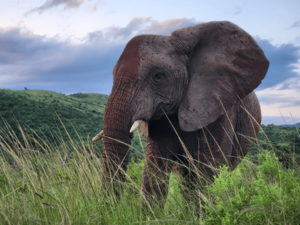
elephant is walking
elephant is walking

South Africa – Understanding elephant movements to better manage their populations

In South Africa, a scientific program is studying elephant movements to better understand population management options in reserves where elephants are becoming abundant and impacting the ecosystem. For example, the project analyzes the link between “elephant pressure” across the landscape and population density, as well as the impact of contraception on the animals’ spatial behaviors and habitat use. The goal is to develop a conceptual framework and an adaptive management tool based on the analysis of elephant movements to better plan for their conservation and that of the ecosystems that support them.

Project overview

Location: South Africa 🇿🇦

Project Leader: Simon Chamaillé-James (opens in a new tab)   

Status: In progress 

Duration: 4 years - August 2023 to August 2027 

Partners: 

Context


Despite its status as a globally threatened species, the African elephant (Loxodonta africana) reaches densities in some protected areas that managers consider too high, particularly due to the massive impact elephants have on vegetation. This paradox is frequently evident in small fenced reserves, which are numerous in South Africa, where population management is a practical necessity. 
 

The current solution: contraception 
 

To control these populations without culling, many reserves rely on contraceptive treatment of females, which is more effective than that of males in terms of population dynamics. The goal is to achieve the ecosystem’s “carrying capacity”, that is, the maximum tolerable density. Problem: although this concept is used as a precise reference by managers, it is in reality poorly defined biologically, rarely estimated based on local data, and often derived from unreliable bibliographic sources. 
 

How do contraception and social behavior affect movement patterns? 
 

Beyond density control, it is now recognized that maintaining spatial heterogeneity in elephants’ impact on the environment, in other words, ensuring that elephants do not always use the same areas, is important for promoting biodiversity as a whole. 

However, contraception could alter elephants’ spatial behaviors through two mechanisms: 

  • By reducing density: individuals naturally alter their use of space when competition decreases (a well-documented phenomenon in many species), although social structure may modulate this response. 
  • By eliminating the presence of very young calves in family groups: herds might move further and more freely, particularly during the dry season when travel is more taxing for calves than for adults.

Scientific issue


Do contraception and sociality alter elephant movements, and if so, how?  

Proposed solution

A research gap to be filled 
 

To date, only one study, of limited robustness, has examined the link between contraception and elephant movements, without finding any effect. Furthermore, how sociality affects herd movements across landscapes remains largely understudied, although field observations suggest its importance.  

In this context, the project proposes a new line of inquiry, seeking to move beyond the concept of carrying capacity by developing an approach based on elephants’ use of space and the heterogeneity of their landscape occupancy. 

This approach is based on: 

  • a detailed analysis of individual and collective movements
  • a study of the effects of contraception on spatial behaviors, 
  • the development of models to simulate and predict habitat occupancy dynamics. 

Project objectives

What the Project aims to demonstrate
 

  • Effects of contraception on movement 
    To assess whether contraception alters elephants’ spatial use and movement dynamics (distance traveled, areas used, seasonality). 
     
  • Understanding behavioral mechanisms 
    Identify how sociality modulates the relationship between local pressure exerted by elephants and overall population density. 
     
  • Development of a management indicator 
    Develop an indicator based on the spatial heterogeneity of habitat use. 
     
  • Development of predictive models 
    Develop simulation tools to help managers anticipate the effects of population control strategies. 
     
  • Application to adaptive management 
    Provide a scientific basis to guide management decisions in reserves (rather than an approach based solely on population thresholds). 

Project implementation

Key milestones

08/2023

Signing of the partnership

06/2026

Ongoing deliverables

Results

The project results have not yet been published but will be as soon as possible.

Ceva WRF's involvement

  • Financial support, 
  • Operational monitoring. 

Glossary

A group of animals living together temporarily or permanently, generally among wild species. (Source: French Office for Biodiversity) 
Adaptive management is a management approach based on continuous learning, which involves adjusting decisions and actions based on observed results and evolving knowledge. (Source: Convention on Biological Diversity)