

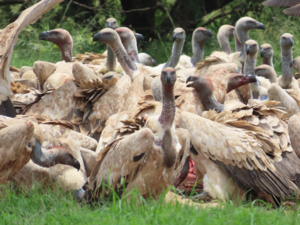
group of vultures
group of vultures

South Africa – Studying the epidemiology of avian influenza and West Nile virus in vultures

This research project investigates the presence of West Nile virus and avian influenza in African vultures, species that are essential to the balance of ecosystems but are now highly endangered. By analyzing their exposure to diseases whose impacts and epidemiology remain poorly understood in vultures, the project aims to better understand the risks to their survival and to global health (animal, human, and environmental).


The goal is to improve the detection and prevention of diseases in African vultures in order to strengthen their protection and the health monitoring of ecosystems.

Project overview

Location: South Africa 🇿🇦

Project Leader: Fiona Fern – PhD Student (opens in a new tab)

Status:  Starting

Duration: 2 years – April 2026 to April 2028

Partner: 

Context

One Health approach 
 

This research is part of a One Health approach, recognizing the interdependence between the health of ecosystems, wildlife, domestic animals, and human populations, with vultures serving as a keystone species at this interface. 
 

Essential ecosystem services 
 

Vultures, as obligate scavengers, play a crucial ecological role in removing carcasses from the environment. This helps reduce the risk of pathogen transmission through water and soil, and also limits the populations of facultative scavengers, such as feral dogs, that would otherwise thrive on the same food source. The importance of this role became clear in India beginning in the 1990s, when vulture populations declined by 97–99% after the birds fed on the carcasses of cattle treated with diclofenac, an anti-inflammatory veterinary drug that is toxic to vultures. With vultures no longer removing carcasses, feral dogs gained access to a much larger food supply, and their population increased dramatically as a result. This growth in the feral dog population led to a rise in rabies transmission between dogs and humans, ultimately contributing to an increase in human mortality.
 

Current threats to African populations 
 

African vultures are experiencing a rapid decline, primarily due to human activities: collisions with electrical infrastructure, habitat destruction, and poisoning via carcasses. At the same time, the role of infectious diseases remains largely understudied, with only 16% of mortality studies addressing this issue.

- White-backed Vulture (Gyps africanus), CR

- Coprotheres Vulture (Gyps coprotheres), VU

- Monk Vulture (Necrosyrtes monachus), CR

- Oricou Vulture (Torgos tracheliotos), EN

- White-headed Vulture (Trigonoceps occipitalis), CR

Project challenges

Increasing vulnerability to disease 
 

Declining populations are accompanied by a reduction in genetic diversity, compromising their ability to adapt to pathogens. This vulnerability increases the risk of extinction.

Pathogens of concern 
 

  • West Nile virus (WNV): This mosquito-borne flavivirus causes severe neurological symptoms that are often fatal. Although it has been detected in North American and European vultures, its prevalence among African species remains unknown. 
  • Highly Pathogenic Avian Influenza (HPAI): Classified as a secondary threat by the Action Plan of the Convention on the Conservation of Migratory Species (CMS), or the Bonn Convention, HPAI poses a major risk of transmission during communal feeding gatherings of vultures. Their ability to travel across borders increases the potential for large-scale spread.

Scientific issue


What is the prevalence of West Nile virus and highly pathogenic avian influenza in African vulture populations, and what implications might these infections have for their conservation and the global health of ecosystems? 

Project objectives

What the Project aims to demonstrate 
 

To deepen our understanding of exposure to infectious diseases in these vulture species by assessing the presence of avian influenza and West Nile virus in wild populations. 

  • The first-ever baseline data collected on AI and WNV in African vultures, 
  • Strengthening national disease surveillance to enable early warning in the event of disease outbreaks, 
  • Improving the assessment, care, and treatment of vultures upon their admission to care centers. Poisoning is one of the main threats to vultures in South Africa. Birds unable to fly that are admitted to care centers with no apparent injuries are presumed to have been poisoned; if the cause is actually viral, different treatment plans and biosecurity measures would be required. 

Project implementation

Key milestones

03/2026

Sampling

05/2026

Project signing

11/2026

End of data collection

2027

Analysis and presentation of final data

Results

The project results have not yet been published but will be as soon as possible. 

Ceva WRF's involvement

Our role in this Project  
 

  • Financial support,
  • Operational oversight.

Glossary

A feral animal is a domesticated animal that has returned to the wild, living freely without depending on humans.
One Health is a concept recognized by the WHO, the FAO, and the OIE, which posits that the health of humans, animals, and ecosystems is closely linked and interdependent, requiring an integrated approach.

A set of preventive measures aimed at reducing the risk of the introduction, spread, and dissemination of pathogens (viruses, bacteria, parasites) among animal and human populations or in the environment. (Source: FAO)