
Pangolin
Pangolin

South Africa – Learning more about Temminck’s pangolins to improve their care and rehabilitation

In South Africa, this thesis project aims to better understand the ecology of the Temminck’s pangolin in order to improve its care and rehabilitation in the wild. The data collected will help optimize care protocols for the species. The goal is to sustainably improve the survival and reintroduction of pangolins through a better understanding of their ecophysiology.

Project overview

Location: South Africa 🇿🇦

Project Leader: Jessie Berndt, PhD Student 
Advisors: Prof. Andrew McKechnie & Prof. Ray Jansen 

Status: In Progress  
Duration: 3 years - 2023 to 2026

Partners:

Context


Pangolins are the most heavily poached mammal on earth and as Temminck's pangolin has the biggest distribution out of Africa's 4 pangolin species, they are heavily targeted too. The eight existing pangolin species are still poorly understood despite having evolved over millions of years. Targets of massive international trafficking, pangolins are now threatened with extinction in Africa and Southeast Asia. 

A dramatic decline in Temminck’s pangolin populations has occurred due to increased demand driven by hunting for local consumption, the illegal wildlife trade, and certain Zulu cultural practices in which the animal may be regarded as a totem offered to traditional chiefs. The species is now considered ecologically extinct in the region, with only isolated individuals remaining and insufficient reproduction to ensure population recovery.

A lack of understanding of its behavior and biological needs greatly complicates conservation and reintroduction efforts, with a still-limited survival rate among rescued individuals. 

Re-introduction project challenges


  • To carry out the world’s first reintroduction of a pangolin species into an area where it has become locally extinct,
  • Establish an international benchmark for pangolin reintroduction and conservation,
  • Guide future conservation decisions using robust scientific field data,
  • Strengthen anti-poaching efforts by improving the effectiveness of rehabilitation and release programs. 

Scientific issue

How can we improve reintroduction protocols for the Temminck’s pangolin by better understanding its ecological needs (diet, habitat, behavior, and movement patterns) in an environment where the species has gone extinct? 
Fichier 5.png

Proposed solution


This program has developed a “soft release” protocol specifically tailored to the Temminck’s pangolin. This method involves gradually acclimating the animal to its new environment before its final release. The acclimatization phase lasts an average of five days, but may vary depending on the individual’s health and ability to adapt. Once released, the pangolins are monitored regularly using radio telemetry to assess their physical condition, movements, and adaptation to the natural environment. 


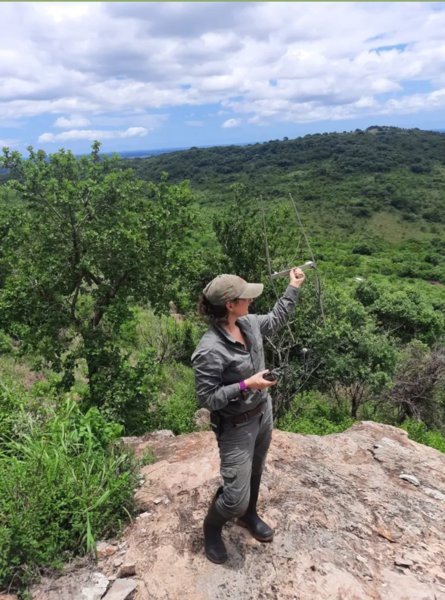
Jessie Berndt

Jessie Berndt (PhD) conducting telemetry measurements

Project objectives

What the Project aims to demonstrate 
 

  • To study the availability and diversity of prey (ants and termites) across different habitats, 
  • Identify pangolins’ dietary preferences based on environmental conditions, 
  • Track movements and home ranges using GPS, VHF, and satellite transmitters over a 2-year period, 
  • Analyze burrow selection based on ecological factors (temperature, season, lunar phase), 
  • To develop a comprehensive conservation plan for Zululand that can be adapted to other regions. 

PhD Project implementation

Key milestones 

07/2023

Signing of the partnership

Results

Thesis currently being written.

Ceva WRF's involvement

Our role in this Project  


  • Financial support, 
  • Operational oversight.

Glossary

Radio telemetry, or “radio tracking,” is a monitoring technique frequently used in conservation ecology. In terrestrial environments, this technology is commonly used to study the spatial distribution and mobility of various species. It relies on the use of a transmitter, an antenna, and a radio receiver (Source: SCIMABIO).

VHF transmitters are radio transmitters used to track the movements of animals via telemetry.

Ecophysiology is the study of the physiological and behavioral responses of living organisms to their natural environment.