


Epidemiology that investigates the determinants of disease at the “micro” (molecular) and individual levels, as well as the “macro” (socio-environmental) level. Identifying causal processes at each of these levels and examining how a process at one level (molecular or social) might manifest itself at another level (disease in an individual) (Source: INSERM, P. Bizouarn)
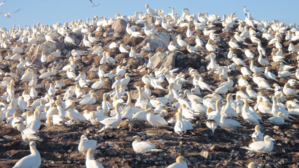
France – Studying the effects of avian influenza on a population of Northern gannets
In France, this project is studying the impact of avian influenza on the Northern Gannet population in the Sept Iles Nature Reserve, which has been severely affected in 2022. It analyzes the spread of the virus and its effects retrospectively through serological monitoring and field data, particularly via GPS. The goal is to better understand and anticipate epizootics in order to ensure the long-term protection of the species.
Context
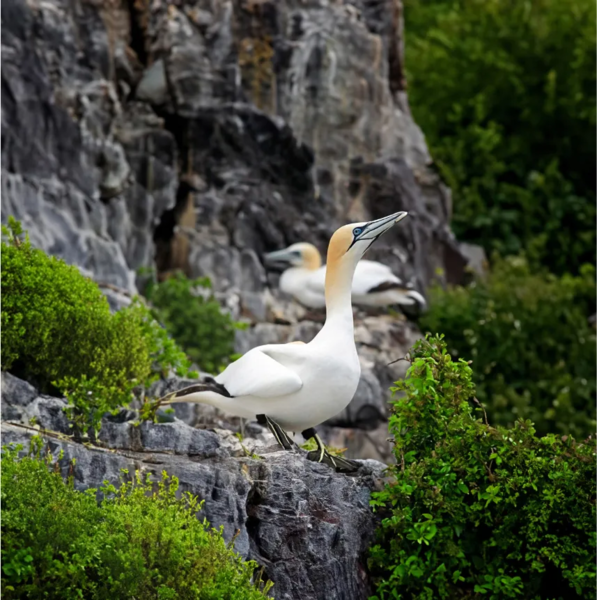
Highly pathogenic avian influenza (HPAI) poses a serious threat to seabird populations, both globally and in Europe. On the island of Rouzic, off the coast of Brittany, France’s only colony of Northern gannets - which once numbered more than 20,000 breeding pairs - was nearly wiped out in 2022 by an HPAI outbreak that affected more than 50% of the adult birds. This vulnerability is primarily due to their breeding habits in dense colonies, which expose Northern gannets (Europe’s largest seabirds) to epizootic risks and highly contagious diseases such as HPAI. Building on its research in the French Southern and Antarctic Lands, the Center for Functional and Evolutionary Ecology (CEFE) has developed recognized expertise in the eco-epidemiology of seabirds.
In response to the major epizootic affecting Northern gannets, the CEFE sought to contribute its expertise to study the transmission processes of HPAI viruses within colonies, as well as the consequences for the populations.
Scientific issue
| How does avian influenza spread within gannet colonies, and what are its short and long-term impacts on their populations? |
 |
Support from Ceva Wildlife Research Fund for this project has enabled us to gather important information for the conservation of a species such as the Northern gannet, whose populations have been affected by highly pathogenic avian influenza. In addition to data on individual movements, we will screen for virus-specific antibodies to determine the proportion of individuals that bred in 2023 who were infected with the virus in 2022. This research allows us to better assess the effects of such a disease on wildlife.
Dr. Thierry Boulinier – CNRS Research Director at CEFE
06/2023
Signing of the partnership
2023
Sampling and installation of GPS-GSM trackers
Results
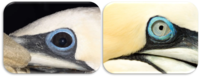
- A first paper reports that individuals with black eyes showed no differences in foraging behaviour or reproductive success in the years following the epizootic compared with individuals with "normal" eyes.
Ponchon, A., Provost, P., Bernard, A., Boulinier, T., Lejeune, M., Lescroel, A., Tornos, J. & Grémillet, D. 2026. No impact of black-eye symptom on foraging behaviour and reproductive success of Northern gannets following highly pathogenic avian influenza. Biological Conservation 313: 111346.
Read the paper (opens in a new tab)
- A second paper will focus specifically on the persistence of avian influenza antibody levels, particularly in individuals with black or speckled eyes. It will initially be available as a preprint in September.