

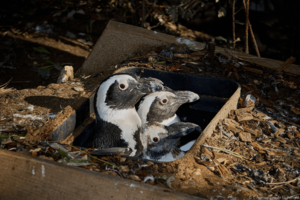
Cape penguins
Cape penguins

France – Exploring a new vaccination strategy against avian influenza in wild birds

In response to avian flu, six French zoos, which already vaccinate their birds, are testing a new, innovative vaccine following a change in regulations. About twenty species, including penguins, raptors, and ostriches, are participating in this campaign, which is part of a scientific research program. The goal is to evaluate the vaccine’s efficacy and safety in order to develop long-term protection tailored to wild birds in zoos.

Project overview

Location: France 🇫🇷

Project Leader: Dr. Alexis Lécu  (opens in a new tab)

Status: In progress  

Duration: Undefined

Partners: 

Context

An unprecedented epizootic in Europe 


Since 2020, Europe has been facing a major outbreak of highly pathogenic avian influenza (HPAI), considered the largest ever observed on the continent. Driven primarily by the H5N1 virus of clade 2.3.4.4b, this crisis affects not only domestic birds but also, since 2022, wild bird populations, resulting in the deaths of several million birds. 

According to the European Food Safety Authority (EFSA) and the European Centre for Disease Prevention and Control (ECDC), the situation is characterized by global geographic spread, a loss of seasonality with year-round viral circulation, and an increasing diversification of affected species, including many captive wild species. 


The situation in France 


According to the World Organization for Animal Health (WOAH) and European reports (EFSA/ECDC), France is particularly vulnerable to avian influenza: 

  • Due to its migratory corridors and wetlands, with recurring outbreaks detected since 2020,
  • Due to the exposure of its zoos, which are in direct or indirect contact with wild birds

Zoos do indeed present specific risk factors:  

  • A high diversity of taxa
  • The presence of susceptible or endangered exotic species
  • Conditions that facilitate intra-collection transmission

Project challenges

Why vaccinate birds?


Until now, French zoos had access to only one inactivated vaccine, which has been in use since 2006. Research by Dr. Mathilde Bosseur (“Implementation and Efficacy of Vaccination Against Highly Pathogenic Avian Influenza in Zoos”) (opens in a new tab) shows that the vaccine response varies by taxon, age, and vaccination history; that viral exposure can occur in vaccinated animals; and that low-level viral circulation may exist, making health surveillance more complex and complicating DIVA (Differentiate Infected from Vaccinated Animals) strategies. 

Recent changes to national regulations, which took effect this summer (DGAL/SDSBEA/2024-145), now provide zoos with access to an innovative vaccine developed by Ceva Santé Animale, paving the way for this research project. 

The objective is to: 

  • Protect sensitive or heritage species, such as pelicans and Cape penguins, and preserve genetic reservoirs, 
  • Limit the constraints associated with biosecurity and containment, which can be stressful, disrupt the animals’ natural behaviors, and be burdensome in the long term by requiring constant effort and significant resources. Furthermore, these measures offer no individual protection: each animal remains susceptible to the disease. 
  • Test innovative solutions such as vaccination strategies tailored to non-domesticated species, by exploring innovative vaccines and developing protocols that are compatible with European regulations and based on the circulating strain 2.3.4.4.b. 

However, for exotic birds, data on efficacy and tolerability remain limited, and immune responses can vary greatly depending on the taxon

This vaccination program reflects Ceva Wildlife Research Fund’s commitment to protecting wildlife, drawing on scientific research to better anticipate and prevent health risks to exotic birds.

Pierre-Marie Borne, Director of Ceva Wildlife Research Fund

Scientific issue


How can we optimize vaccination strategies to effectively protect captive birds, standardize immune responses, and improve viral surveillance, particularly through new vaccination technologies and approaches DIVA ? 

Proposed solution

A next-generation vaccine  


The project is based on a vaccine developed by Ceva Santé Animale, originally designed for domestic and farm animals, and whose efficacy is being evaluated here in captive exotic species. 

This technology offers several key advantages in a zoological context:  

  • TECHNOLOGY: low species barrier and safety.
  • ADAPTATION: current circulating strains.
  • ENVIRONMENTAL IMPACT: no environmental release.
  • PRACTICALITY: reduced injection volume.
  • DIAGNOSTICS: differentiation between vaccinated and infected birds (DIVA).
hand drawn MANCHOT

Project objectives

The project, supported by Ceva Wildlife Research Fund, in collaboration with the French Association of Zoo Veterinarians and led by French zoos:  

  • Draws directly on the limitations identified under real-world conditions
  • Aims to evaluate and optimize vaccination strategies in zoos.

It enables:  

  • The generation of multi-species scientific data under controlled conditions
  • The improvement of protocols (dose, booster, targeting), 
  • The evaluation of new vaccination approaches tailored to current challenges.


What the project seeks to demonstrate


  • Immunological efficacy 

To evaluate the vaccine’s ability to induce a protective humoral response and to measure the variability of this response across species (raptors, Anseriformes, Phoenicopteriformes, Pelecaniformes, etc.). It is also important to note that the vaccine induces a significant cellular response in addition to the humoral response, although this cannot currently be measured due to a lack of available tools. 

  • Safety and tolerability 

Verify the absence of clinical adverse effects, particularly in sensitive or endangered species. 

  • Applicability in real-world conditions 

Validate feasibility in a zoological context: individual traceability, tagging, monitoring, and compliance with European regulations. 

  • Knowledge enhancement  

Generate serological reference data for non-domestic avian species and contribute to the development of a protection protocol tailored to captive exotic species in the face of HPAI. 


This project is fully aligned with an applied research approach, at the intersection of animal health, conservation, and vaccine innovation. 

Project implementation

Key milestones 

11/2025

Vaccination campaign

04/2026

Signing of the partnership

Results

The project results have not yet been published but will be available soon. 

Ceva WRF's involvement

Our role in this Project


  • Logistical support: provision of vaccines and vaccination equipment, 
  • Scientific expertise: assistance in developing protocols for vaccinating and monitoring birds, 
  • Financial support for laboratory analyses, 
  • Operational monitoring.

Glossary

An epizootic is a disease that spreads rapidly within an animal population, similar to an epidemic among humans. (Source: WHO) 
A geographic area regularly traversed by animal species during their seasonal movements, particularly between their breeding, foraging, and wintering grounds. (Source: Food and Agriculture Organization of the United Nations) 

A unit of classification of living organisms, used to group organisms with common characteristics. (Source: Systematic biology literature)

Relating to the humoral immune response, that is, the part of the immune system involving antibodies produced by B lymphocytes and circulating in body fluids (blood, lymph). 

Data relating specifically to antibodies studied in serum (serology) for a given disease.

Differentiating Infected from Vaccinated Animals: a strategy used in animal health that makes it possible to distinguish infected animals from those that are simply vaccinated, using specific vaccines and diagnostic tests. (Source: WOAH/OIE) 

The set of preventive measures aimed at reducing the risk of introduction, spread, and dissemination of pathogens (viruses, bacteria, parasites) among animal and human populations or in the environment. (Source: FAO) 

Refers to a vaccine (often inactivated or non-replicating) whose components are unable to multiply, spread, or be excreted by the vaccinated animal into the environment. (Source: European Medicines Agency)

A type of scientific research aimed at generating knowledge that can be directly applied to solve practical problems (e.g., vaccine development, improvement of medical or agricultural practices). (Source: OECD)