
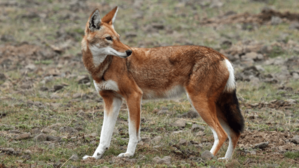


Ethiopian wolf
Ethiopian wolf

Ethiopia – Vaccinating Ethiopian wolves to protect them from rabies

This project in Ethiopia aims to protect the Ethiopian wolf, the world’s rarest canid, which is severely threatened by fatal diseases such as rabies, transmitted by domestic dogs, which serve as a reservoir for the disease.
The goal is to implement an oral vaccination program using bait to prevent the spread of rabies among wolf populations and limit outbreaks that cause high mortality rates among Ethiopian wolf populations. 

Project overview

Location: Ethiopia. 🇪🇹

Project Leader: Claudio Sillero (opens in a new tab)  

Status: Starting

Duration: Undefined

Partners: 

Context


The Ethiopian wolf (Canis simensis) is Africa’s most endangered carnivore and the world’s rarest canid, with approximately 454 adult individuals distributed across isolated populations in the Ethiopian highlands. 

The species is severely threatened by zoonotic diseases, particularly rabies and distemper, transmitted by domestic dogs. Several major epizootics have been recorded over the past few decades, resulting in mortality rates of up to 75% in some populations. 

Injectable vaccination campaigns have helped limit the spread of cases when an epizootic outbreak occurs, but a preventive and less invasive approach is still needed to avoid these sudden declines. 

Project challenges


The development of an effective oral vaccination strategy would make it possible to: 

  • To take preventive rather than reactive action
  • To limit mass mortality
  • To stabilize population sizes. 

This project is also part of a “One Health approach, integrating animal, human, and environmental health.

Scientific issue


How can we develop an effective oral vaccination method tailored to the Ethiopian wolf, ensuring high uptake of the vaccine baits and a sufficient immune response at the population level? 

Proposed solution


The project involves deploying an oral vaccination program using baits containing the rabies vaccine from Ceva Santé Animale.  

Field campaigns will be conducted in the Bale Mountains National Park and among other populations, with monitoring of bait ingestion and vaccine efficacy. 

Serological monitoring (blood and potentially fecal tests) will be used to assess the animals’ immune response.

Project objectives


  • To develop a reliable method of oral vaccination for the Ethiopian wolf, 
  • Improve the consumption rate of vaccine baits, 
  • To evaluate the immune response in vaccinated individuals, 
  • Extend this strategy to all populations of the species, 
  • Strengthen long-term conservation strategies

Project implementation

Key milestones

07/2026

Signing of the partnership

2027

Coming soon

Vaccination campaign in 2026–2027, subject to the progress of regulatory procedures.

Results

The project results have not yet been published but will be as soon as they are available.

Ceva WRF’s involvement

Our role in this Project  


  • Logistical support: shipping vaccines to Ethiopia, 
  • Financial support: covering the costs of laboratory tests for serological monitoring, 
  • Operational monitoring. 

Glossary

One Health is a concept recognized by the WHO*, the FAO**, and WOAH***, which posits that the health of humans, animals, and ecosystems is closely linked and interdependent, requiring an integrated approach.

*WHO: World Health Organisation
**FAO : Food and Agriculture Organization of the United Nations
***WOAH : World Organisation for Animal Health

Serological surveillance uses blood tests to detect the presence of antibodies to a specific disease, thereby determining past or current exposure to infectious agents.

In epidemiology, a reservoir species refers to a species in which a pathogen proliferates. These reservoirs often play multiple roles by enabling the pathogen’s development, its transmission to other organisms, and its spread within the environment.

An epizootic is a disease that spreads rapidly within an animal population, similar to an epidemic in humans. (Source: WHO) 

Zoonoses are diseases or infections that are naturally transmitted between animals and humans. (Source: WHO)