


Gelada baboon
Gelada baboon

Ethiopia – Studying the gelada baboon microbiome to promote public health (PhD)

Spanning Ethiopia and southern France, this doctoral thesis investigates the pathogens present in the microbiome of geladas to better understand health risks at the interface between wildlife, domestic animals, and humans. The results will help identify potential zoonotic risks and better anticipate disease outbreaks. The microbiome is also viewed as a reflection of the circulation of infectious agents at the interface between these different compartments. The goal is to contribute to a One Health approach to protect both wildlife, including endemic and endangered species, and human health.

Project overview

Location: Ethiopia 🇪🇹

Project Leader: Dr. Zerehun Asefa (opens in a new tab) 

Status: In Progress

Duration: 3 years - 2024 to 2027

Partners: 

(opens in a new tab) Logo IHU Méditérannée Infection
RITMES (Tropical Infectious Risks and Emerging Microorganisms) UMR D257 Aix-Marseille University, French Armed Forces Health Service, Marseille University Hospitals
(opens in a new tab) addis abbeba
College of Veterinary Medicine & Agriculture

Context


Geladas (Theropithecus gelada) are primates endemic to the Ethiopian highlands, living at altitudes ranging from 1,800 to over 4,000 meters. Their population is estimated at between 50,000 and 60,000 individuals. They feed primarily on grasses, herbs, and young shoots.

The species is subdivided into three geographically distinct populations in Ethiopia:

  • T. gelada gelada (north)
  • T. gelada obscurus (central)
  • T. gelada ssp. nov. (south, undescribed subspecies)

Classified as “Vulnerable” on the IUCN Red List, the northern population (T. g. gelada) is particularly vulnerable to habitat loss due to growing population pressure (Ethiopia’s population could reach 200 million by 2050) and climate change.

Despite their ecological importance, geladas have been studied very little in terms of transmissible pathogens, with the exception of a few targeted studies (notably on Taenia serialis). This lack of data severely limits our understanding of the health risks at their interface with other species.

Project challenges

  • Understanding the circulation of infectious agents in ecosystems where wildlife, domestic animals, and humans coexist,
  • Anticipating emerging risks of zoonotic diseases in areas under high anthropogenic pressure,
  • Providing scientific knowledge on species that are understudied but ecologically key,
  • Strengthen conservation strategies in the context of rapid environmental change,
  • Contribute to an integrated One Health approach applied to tropical regions of Africa.

Scientific issue


How can we characterize the pathogens present in the microbiome of geladas in order to assess zoonotic at the interface between wildlife, domestic animals, and human populations in Ethiopia?


Proposed solution

Cutting-edge analytical technologies 


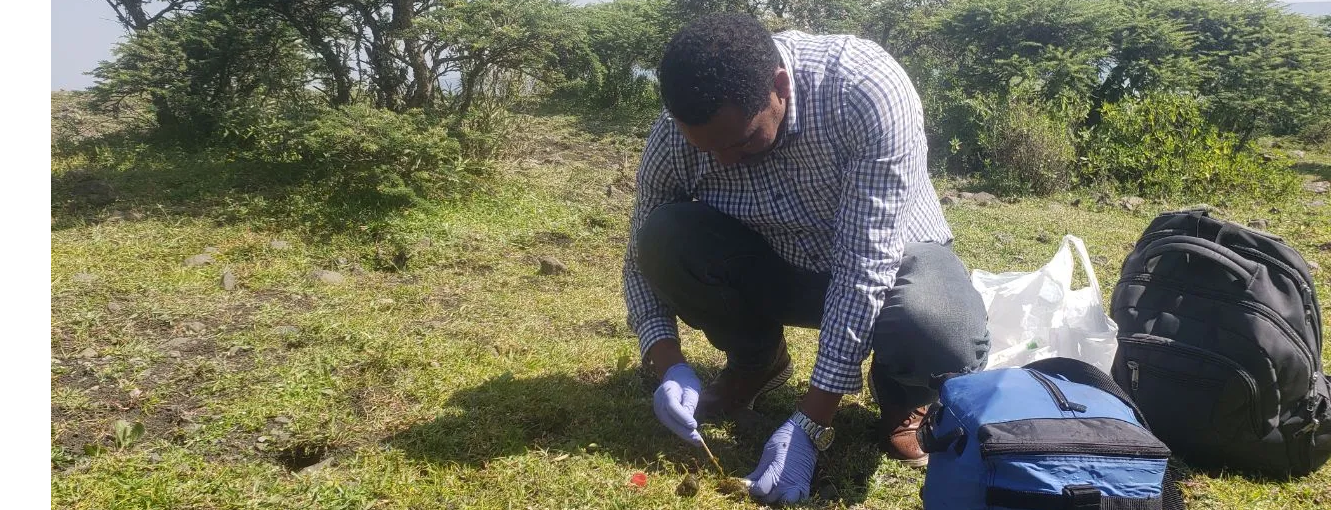
The process involves collecting fecal samples from geladas in Ethiopia, which are then analyzed in Marseille at the IHU Méditerranée Infection using state-of-the-art technologies:

  • Global metagenomics: a large-scale exploratory approach that describes the entire composition of the microbiome and provides an overall “fingerprint,”
  • Targeted viral metagenomics: specific enrichment of viral DNA/RNA to identify all present strains, including new variants,
  • Fecal serology: an innovative method for detecting antibodies and tracing past exposure to pathogens.


Zerehun Asefa

Caption: Dr. Zerehun Asefa - Field sampling in Ethiopia 

Project objectives

What the Project aims to demonstrate 


  • To assess zoonotic risks (from geladas to humans and vice versa) by characterizing the pathogens (viral, bacterial, fungal, parasitic) found in fecal samples from geladas in Ethiopia (from different populations).
  • To characterize the diversity of microorganisms present in the gelada microbiome (viruses, bacteria, fungi, parasites, archaea),
  • Study the dynamics of infectious agent transmission between species,
  • Identify risks of zoonotic transmission at the human–animal–environment interface,
  • Generate actionable scientific data for epidemiological surveillance,
  • Provide recommendations for disease prevention and population conservation.


Project implementation

Key milestones 

06/2024

Signing of the partnership agreement

12/2024

Field missions (3 months each) - Sample collection

2025

Analysis and identification of 2,024 samples

12/2025

Field missions (3 months each) - Sample collection

2026

Analysis and identification of samples from 2025

Results


Laboratory analyses target up to 50 potentially pathogenic microorganisms (viruses, bacteria, archaea, fungi, and parasites).

More detailed results will be available soon.


Ceva WRF’s involvement

Our role in this Project 


  • Financial support,
  • Operational monitoring: on-the-ground support and facilitation.


One Health is a concept recognized by the WHO*, the FAO**, and the WHOA***, which posits that the health of humans, animals, and ecosystems is closely linked and interdependent, requiring an integrated approach.

*WHO: World Health Organisation
**FAO : Food and Agriculture Organization of the United Nations
***WOAH : World Organisation for Animal Health


The collective term for microorganisms living in a complex community, consisting mainly of bacteria but also including archaea, fungi, and viruses. For example, the gut microbiota. (Source: INRAE)

The microbiome refers to the microbiota and the functions it performs within a given ecosystem.

Refers to species that occur naturally only in a given geographic area and nowhere else in the world. (Source: International Union for Conservation of Nature)

Zoonoses are diseases or infections that are naturally transmitted between animals and humans. (Source: World Health Organisation) 

Archaea are a domain of life consisting of unicellular prokaryotic microorganisms, distinct from bacteria and eukaryotes. (Source: Microbiology literature)

A slightly different version of a virus or organism resulting from mutations in its genome.

Metagenomics is a genetic research approach that involves directly analyzing all the genomes present in an environmental sample, without the need to culture the microorganisms. (Source: National Institute for Research on Agriculture, Food, and the Environment)

Epidemiological surveillance is a process aimed at collecting, recording, processing, disseminating, and analyzing data related to public health events to prevent, detect, and control diseases in a population.

DNA: Deoxyribonucleic acid. A macromolecule consisting of two strands wound into a double helix that carries genetic information.

RNA: Ribonucleic Acid. A single-stranded molecule that enables the synthesis of proteins from the genetic information contained in DNA.