

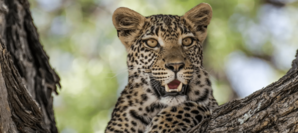
Leopard in a tree
Leopard in a tree

Botswana – Coexisting with leopards through natural solutions

In Botswana, the BioBoundary project aims to reduce leopard attacks on livestock using natural scents that repel them. These simple, eco-friendly solutions protect herds without killing wild animals. The goal is to enable livestock farmers and leopards to coexist safely through natural solutions.

Project overview

Location: Botswana 🇧🇼

Status: In progress  

Duration: 2 years - 2024 to 2026

Partners: 

Context


Populations of large carnivores are declining worldwide due to habitat loss and conflicts with humans, which pose the greatest threat to their survival.  
At the same time, predation on livestock results in significant economic losses: 

  • South Africa: $58.5 million annually (1 billion South African rand annually).
  • United States: $138.5 million annually (small livestock and cattle).


The underutilized potential of chemical signals 


Chemical signals in mammals play a major role in their behavior and physiology, offering significant potential for the management of so-called “pest” animals. However, this approach remains largely underutilized, as these signals have long been considered mixtures that are too complex, costly to reproduce, and difficult to apply in the field. 

In reality, these tools - known as semiochemicals - can be based on simple, even single, compounds that are easy to produce and economically viable. 

The project supported by Ceva Wildlife Research Fund focuses exclusively on the leopard. 

Project objectives


  • Conservation of threatened species: erduce retaliatory killings to help preserve large carnivores, particularly the leopard. 
  • Reducing human–wildlife conflicts: promoting sustainable coexistence between livestock farmers and predators in rural areas. 
  • Securing livelihoods: minimizing economic losses to local communities resulting from livestock predation. 
  • Development of non-lethal solutions: promoting effective alternatives to traditional methods of predator removal. 
  • Applied scientific innovation: validating the use of chemical signals as an operational tool for wildlife management. 
  • Transferability of results: creating a replicable model that can be applied to other species and in other regions of the world. 

Scientific issue

How can chemical compounds derived from predators’ social signals be used to modify their predation behavior, in order to reduce attacks on livestock while avoiding retaliatory culls? 
LEOPARD-CRAYON_2.png

Proposed solution

The BioBoundary Project’s innovation


The BioBoundary project is developing innovative repellents based on predators’ social odors to reduce predation on livestock and limit retaliatory culling by herders. The results show that: 

  • Wild African predators react to unique components of their social odors, 
  • Responses depend on the release rate, 
  • Semiochemical repellents effectively protect livestock under real-world conditions. 

A specific molecule, 3M3MB, derived from leopard urine, was identified and selected as a key component for the trials. 

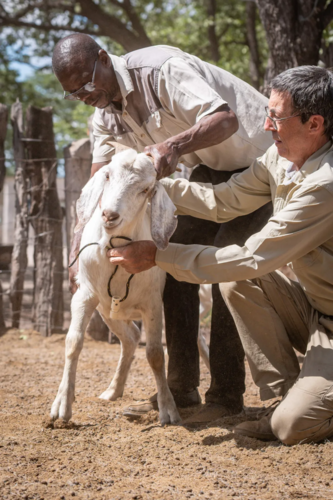
The BioBoundary system relies on two complementary application methods: diffusers installed around enclosures and/or collars worn directly by the livestock. These systems release the 3M3MB molecule in a controlled manner, creating a natural olfactory barrier that deters predators from approaching the herds. 

chèvre et soignants
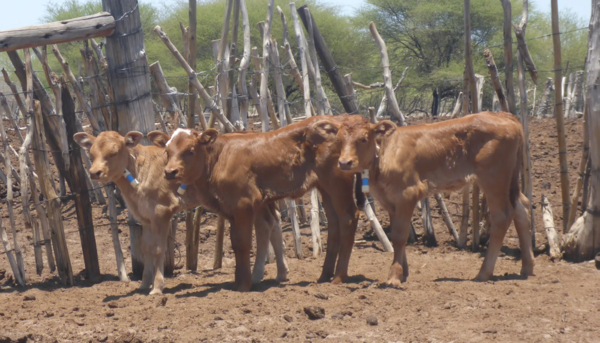
Vaches Traitée

                Fitting collars on a herd.

Project objectives

What the Project aims to demonstrate 
 

  • To improve our understanding of chemical signals in Mammals,  
  • Develop wildlife management tools that are minimally invasive, ecologically benign, and economically viable, with potential applications in agriculture and veterinary medicine, 
  • To create effective repellents against large carnivores to protect livestock, 
  • To sustainably reduce human-wildlife conflicts.  

Project implementation

Key milestones

07/2024

Signing of the partnership agreement

Results

Encouraging initial results:  


  • 3M3MB, derived from leopard urine, induces avoidance behavior in certain predators, 
  • The controlled release of the compound allows it to act from a distance without direct contact, 
  • Equipping just a portion of the herd is sufficient to create an overall protective effect
  • Predation pressure can be significantly reduced or even eliminated in certain areas. 

Real-world examples: 

  • A small herd that was losing one goat per day saw all losses cease for five months after the goats were fitted with BioBoundary predator-repellent collars. 
  • On a ranch where four leopards were detected by camera traps, the goats and sheep were protected for 16 months thanks to predator-repellent collars. 
  • Young cattle stopped being attacked by spotted hyenas immediately after being fitted with collars containing 3M3MB
     

Ceva WRF’s involvement

Our role in this project  


  • Financial support, 
  • Scientific expertise, 
  • Operational oversight, 
  • Donation of equipment and logistical support. 

Glossary

A chemical substance used for communication between living organisms.
A molecule derived from leopard urine that acts as an avoidance signal for predators.

A repellent system based on natural chemical signals.