


Penguins.jpg
Penguins.jpg

Belgium - Studying avian flu vaccination in pelicans and African penguins

Following the 2022 avian flu outbreak, Pairi Daiza, a Belgian park, lost several pelicans. To better protect its vulnerable birds, the park is conducting a research and vaccination project in partnership with Ceva Wildlife Research Fund as well as with Sciensano for serological testing. The goal: to evaluate the vaccine’s efficacy and safety in order to develop long-lasting protection tailored to wild birds.

Project overview

Location: Belgium 🇧🇪

Status: In progress  

Duration: Undefined 

Partners

Context

An unprecedented epizootic in Europe 


Since 2020, Europe has been facing a major outbreak of highly pathogenic avian influenza (HPAI), considered the largest ever observed on the continent. Driven primarily by the H5N1 virus of clade 2.3.4.4b, this crisis affects not only domestic birds but also, since 2022, wild bird populations, resulting in the deaths of several million birds. 

According to the European Food Safety Authority (EFSA) and the European Centre for Disease Prevention and Control (ECDC), the situation is characterized by global geographic spread, a loss of seasonality with year-round viral circulation, and an increasing diversification of affected species, including many captive wild species. 


The situation in Belgium 


In Belgium, the situation is being closely monitored by the National Institute for Public Health (Sciensano), which emphasizes that: 

During the winter of 2021, high mortality rates among black-headed gulls were observed in several European countries, including Belgium, leading to the death of some raptors, which are known to occupy the top of the food chain. Due to its intense and continuous circulation, this virus can also infect birds in wildlife parks.

Bénédicte Lambrecht, Head of the Avian Virology and Immunology Department, Sciensano

Project challenges

Why vaccinate birds? 
 

In 2022, Pairi Daiza lost several birds to this virus, illustrating the real vulnerability of zoological collections. Prior to this project, no vaccination strategy was in place : biosecurity and containment were the only protective measures. To better protect these birds, vaccination appears to be a complementary solution to: 

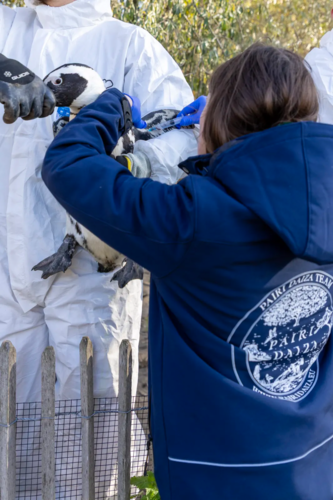
Soigneur du Zoo Pairi Daiza s'occupant d'un manchot
  • Protect sensitive or heritage species such as pelicans (Pelecanus) and African penguins (Spheniscus demersus), and maintain genetic reservoirs, 
     
  • Limit the constraints associated with biosecurity and containment, which can be stressful, disrupt the animals’ natural behaviors, and be burdensome in the long term by requiring constant effort and significant resources. Furthermore, these measures offer no individual protection: each animal remains vulnerable to the disease. 
     
  • Test innovative solutions such as vaccination strategies tailored to non-domesticated species, by exploring vaccines and developing protocols that are compatible with European regulations and based on the circulating strain 2.3.4.4.b. 


However, in birds, and particularly in exotic species: 

  • Data on efficacy and tolerability remain limited, 
  • Immune responses can vary greatly depending on the taxon


Scientific issue


To what extent can an innovative vaccination strategy serve as an effective, safe, and practical solution to protect multi-species captive avian populations against highly pathogenic avian influenza? 

Proposed solution

A next-generation vaccine  
 

The project is based on a vaccine developed by Ceva Santé Animale, originally designed for domestic and farm animals, and whose efficacy is being evaluated here in captive exotic species. 

This technology offers several key advantages in a zoological context:  

  • TECHNOLOGY: low species barrier and safety,
  • ADAPTATION: current circulating strains,
  • ENVIRONMENTAL IMPACT: no environmental release,
  • PRACTICALITY: reduced injection volume,
  • DIAGNOSTICS: differentiation between vaccinated and infected birds (DIVA). 
MANCHOT-CRAYON.png

We contacted Sciensano, the national reference laboratory, because we knew that new vaccines were being developed in light of the unprecedented impact of this avian influenza pandemic. We evaluated several options to protect our birds and decided to start with peacocks and pelicans, which appear to be the most vulnerable. Since we did not have a vaccine specifically designed for wild animals, we opted for an innovative vaccine, initially developed for domestic and farm animals.

Alicia Quievy, veterinarian at Pairi Daiza

Project objectives

What the Project aims to demonstrate 
 

  • Immunological efficacy 

To evaluate the vaccine’s ability to induce a protective humoral and/or cellular immune response, and to measure the variability of this response across species (raptors, Anseriformes, Phoenicopteriformes, Pelecaniformes, etc.). It is also important to note that the vaccine induces a significant cellular immune response in addition, although this cannot currently be measured due to a lack of available tools. 

  • Safety and tolerability 

Verify the absence of clinical adverse effects, particularly in sensitive or endangered species. 

  • Applicability in real-world conditions 

Validate feasibility in a zoological setting: individual traceability, tagging, monitoring, and compliance with European regulations. 

  • Knowledge enhancement  

Generate serological reference data for non-domestic avian species and contribute to the development of a protection protocol tailored to captive exotic species in the face of HPAI. 


This project is fully aligned with an applied research approach, at the intersection of animal health, conservation, and vaccine innovation.

Project implementation

Key milestones

01/2023

Signing of the partnership agreement

2023

Vaccination of the pelicans

2024

Vaccination of Cape Penguins

2025

International presentation

This scientific and conservation adventure began at Pairi Daiza. Three years later, the initial results are encouraging and suggest good vaccine tolerance with the potential to protect the most vulnerable birds.

Pierre-Marie Borne, Director of Ceva Wildlife Research Fund

Results

The project’s results have not yet been published but will be soon.

Ceva WRF’s involvement


  • Logistical support: provision of vaccines and vaccination equipment, 
  • Scientific expertise: assistance in developing protocols for vaccinating and monitoring birds, 
  • Financial support for laboratory analyses. 


These initiatives in zoos are important for improving prevention strategies while preserving individuals of high conservation value. 

Glossary

Differentiating Infected from Vaccinated Animals: a strategy used in animal health that distinguishes infected animals from those that are simply vaccinated, using specific vaccines and diagnostic tests. (Source: WOAH/OIE)
A set of preventive measures aimed at reducing the risk of the introduction, spread, and dissemination of pathogens (viruses, bacteria, parasites) in animal populations, humans, or the environment. (Source: FAO)

Refers to a vaccine (often inactivated or non-replicating) whose components are incapable of multiplying, spreading, or being excreted by the vaccinated animal into the environment. (Source: European Medicines Agency)

Relating to the humoral immune response, that is, the part of the immune system involving antibodies produced by B cells and circulating in body fluids (blood, lymph). 

A type of scientific research aimed at generating knowledge that can be directly applied to solve practical problems (e.g., vaccine development, improvement of medical or agricultural practices). (Source: OECD) 

A unit of classification for living organisms, used to group organisms with common characteristics. (Source: Systematic biology literature)

An epizootic is a disease that spreads rapidly within an animal population, similar to an epidemic in humans. (Source: WHO) 

Data relating specifically to antibodies studied in serum (serology) for a given disease.